
Reimagining Climate Governance through Pluralism and Perspective


By: 1. Prof. Ashok Kumar (Founder and Chairman)
2. Niranjan Dev Bharadwaj (Researcher and Advisor)
As the climate crisis deepens, it is becoming increasingly evident that the challenge before humanity is not merely environmental—it is epistemological, political, and cultural. Climate change resists simplistic solutions because it is, by nature, a multi-dimensional problem, embedded in competing interests, diverse knowledge systems, and unequal global realities.
In navigating this complexity, the philosophy of Mahavira offers a profound and underexplored framework: Anekantavada—the doctrine of multiple viewpoints. Often interpreted as intellectual humility or the acceptance of partial truths, Anekantavada has far-reaching implications for climate dialogue, policy-making, and global cooperation.
It invites us to move beyond rigid binaries and toward a more inclusive, dialogic, and integrative approach to environmental governance.
Understanding the Complexity of Climate Change

Climate change is not a singular issue that can be addressed through a single discipline or policy. It exists at the intersection of:
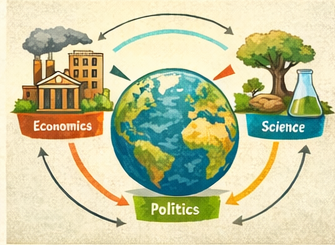
- Science: Atmospheric chemistry, ecological thresholds, carbon cycles
- Politics: National interests, global negotiations, power asymmetries
- Economics: Development models, industrial growth, resource allocation
- Culture: Lifestyles, traditions, consumption patterns
For instance:
- A developed nation may prioritize emission reductions
- A developing nation may emphasize economic growth and poverty alleviation
- Indigenous communities may focus on land rights and ecological balance
Each perspective is valid within its own context, yet incomplete in isolation. Anekantavada recognizes this inherent complexity. It asserts that truth is not absolute from a single standpoint, but emerges through the coexistence of multiple perspectives.
The Limitations of One-Dimensional Solutions
Many climate policies fail not because they lack scientific validity, but because they are one-dimensional.
- Technocratic solutions often ignore social realities
- Economic policies may overlook ecological limits
- Global agreements sometimes fail to account for local contexts
For example:
A uniform climate policy imposed globally may disregard the developmental needs of emerging economies or the traditional practices of indigenous communities.
Such approaches create resistance, conflict, and inefficiency.
Anekantavada challenges this reductionism. It cautions against the assumption that any single framework—scientific, economic, or political—can fully capture the complexity of climate change.
Instead, it calls for multi-perspectival integration, where diverse viewpoints are not seen as obstacles, but as essential components of truth.
Valuing Indigenous Knowledge: Wisdom Rooted in Harmony
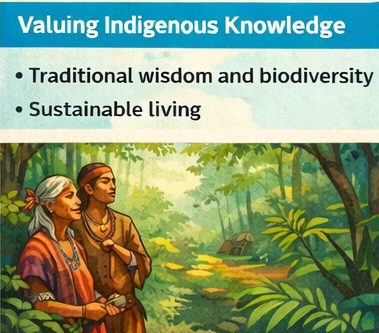
One of the most critical yet often overlooked dimensions of climate governance is indigenous knowledge.
For centuries, indigenous communities have:
- Lived in harmony with nature
- Developed sustainable agricultural practices
- Preserved biodiversity through traditional stewardship
However, modern policy frameworks frequently marginalize these knowledge systems in favor of formal scientific models.
Anekantavada offers a corrective lens. It emphasizes that no single knowledge system holds a monopoly over truth.
Integrating indigenous wisdom with modern science can lead to:
- More resilient ecosystems
- Context-specific solutions
- Culturally sensitive policies
In doing so, climate action becomes not only effective but also equitable and respectful.
Empowering Local Communities: From Subjects to Stakeholders

Environmental policies often operate in a top-down manner, where decisions are made at global or national levels and implemented locally.
This approach overlooks a crucial reality:
Local communities are not just affected by climate change—they are key agents of change.
Anekantavada reinforces the need to:
- Include local voices in decision-making
- Recognize community-specific challenges and solutions
- Promote participatory governance
For example:
- Coastal communities understand sea-level changes intimately
- Farmers possess generational knowledge of soil and weather patterns
Incorporating these perspectives leads to grounded and sustainable outcomes.
Interdisciplinary Approaches: Bridging Knowledge Silos
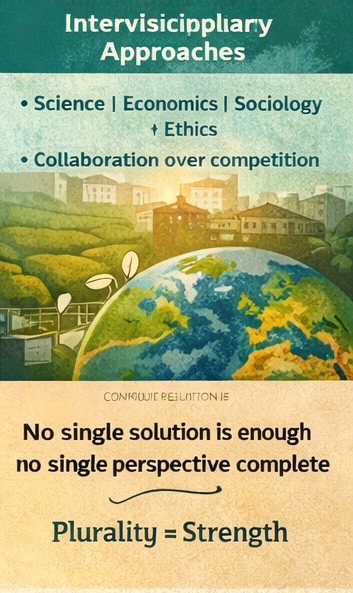
Climate change cannot be solved within disciplinary silos. It demands collaboration across:
- Environmental science
- Economics
- Sociology
- Law and governance
- Ethics and philosophy
Anekantavada inherently supports this interdisciplinary integration. By acknowledging the partial nature of each perspective, it encourages collaboration rather than competition among disciplines.
This approach enables:
- Holistic policy design
- Comprehensive risk assessment
- Innovative and adaptive solutions
In essence, Anekantavada transforms fragmentation into synergy.
Conflict Resolution in Environmental Policy
Climate negotiations are often marked by conflict:
- Developed vs developing nations
- Economic growth vs environmental protection
- Short-term gains vs long-term sustainability
These conflicts arise from competing truths—each side grounded in its own valid perspective.
Anekantavada provides a philosophical foundation for conflict resolution by:
- Encouraging dialogue over domination
- Promoting understanding over polarization
- Seeking synthesis rather than victory
It does not demand that one perspective replace another. Instead, it fosters a space where multiple truths can coexist and inform balanced solutions.
This is particularly relevant in international climate diplomacy, where consensus is essential but often elusive.
Anekantavada as India’s Soft Power in Climate Diplomacy
In the global search for sustainable solutions, technical innovations and financial mechanisms often dominate the discourse. However, there is a growing recognition that philosophical and cultural frameworks also have a critical role to play.
Herein lies an opportunity for India.
Anekantavada, as a civilizational philosophy, offers a unique soft-power contribution to global climate governance. It embodies:
- Intellectual humility
- Respect for diversity
- Commitment to dialogue
By integrating Anekantavada into climate diplomacy, India can:
- Promote inclusive global negotiations
- Bridge divides between nations
- Advocate for equitable and pluralistic solutions
This is not merely a philosophical export—it is a strategic intervention in shaping the future of global environmental governance.
Conclusion: From Fragmentation to Harmony
The climate crisis is not just a test of our technologies or policies—it is a test of our ability to think collectively, act inclusively, and govern wisely.
Anekantavada offers a path forward. It reminds us that:
- No single solution is sufficient
- No single perspective is complete
- No single actor can solve a global crisis
In embracing plurality, we move closer to truth.
In fostering dialogue, we move closer to solutions.
Final Reflection
In a world divided by perspectives, Anekantavada teaches us that diversity of thought is not a weakness—it is our greatest strength in addressing the climate crisis.