From Excess to Essence: A Civilizational Response to Climate Change


1. Prof. Ashok Kumar (Founder and Chairman)
2. Niranjan Dev Bharadwaj (Researcher and Advisor)
In an era defined by relentless consumption, where economic growth is often measured by how much we produce and consume, the climate crisis stands as a stark reminder of the limits of this model. Rising emissions, resource depletion, and ecological imbalance are not accidental—they are deeply rooted in patterns of overconsumption.
On this critical front, the teachings of Mahavira offer a radical yet profoundly relevant alternative. His principle of Aparigraha—non-possessiveness or limiting one’s material desires—is not merely a spiritual discipline; it is a blueprint for sustainable living in a carbon-constrained world.
Overconsumption: The Hidden Driver of Climate Change
Climate change is often framed in terms of emissions, industries, and policies. But beneath these visible layers lies a more fundamental cause: the culture of excess.
- The demand for fast fashion accelerates textile waste and water pollution
- Mass production drives deforestation and industrial emissions
- Consumer lifestyles increase energy use, transport demand, and waste generation
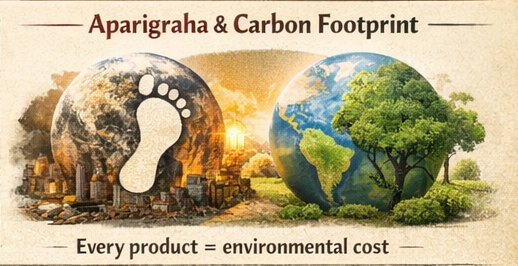
Every product we consume carries an environmental cost—what we call a carbon footprint. The more we consume, the more we extract, produce, and pollute.
In this sense, climate change is not just an industrial problem—it is a behavioral crisis.
Aparigraha directly confronts this root cause by asking a simple yet transformative question:
How much do we really need?
Minimalism vs Materialism: A Shift in Consciousness
Modern consumer culture thrives on materialism—the belief that accumulation leads to happiness and success. Advertising, social norms, and economic systems reinforce this mindset, creating a cycle of desire and dissatisfaction.
Aparigraha disrupts this cycle. It proposes minimalism not as deprivation, but as liberation.
- Liberation from unnecessary wants
- Liberation from wasteful habits
- Liberation from the ecological burden of excess
Minimalism, in this context, is not about owning nothing—it is about owning responsibly.
Where materialism says: “More is better,”
Aparigraha responds: “Enough is abundance.”

Aparigraha and Carbon Footprint Reduction
At its core, Aparigraha is about reducing one’s impact on the Earth. When translated into contemporary environmental terms, it becomes a powerful tool for carbon footprint reduction.
Consider the implications:
- Buying fewer goods reduces manufacturing emissions
- Consuming local products cuts transportation-related carbon
- Avoiding waste lowers landfill emissions
Each act of restraint becomes an act of climate responsibility.
Unlike technological solutions that require large-scale adoption, Aparigraha operates at the individual level, making climate action immediate and accessible.
Aparigraha and the Circular Economy
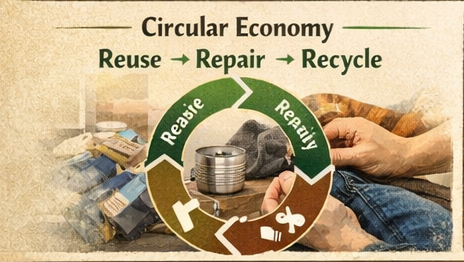
The modern linear economy follows a simple pattern: take → make → dispose. This model is inherently unsustainable.
Aparigraha aligns naturally with the concept of a circular economy, where:
- Products are reused, repaired, and recycled
- Waste is minimized
- Resources are kept in circulation for as long as possible
By discouraging excessive accumulation, Aparigraha reduces the pressure on resource extraction and encourages mindful utilization.
It transforms consumption from a linear act into a cyclical responsibility.
Aparigraha and the Degrowth Discourse
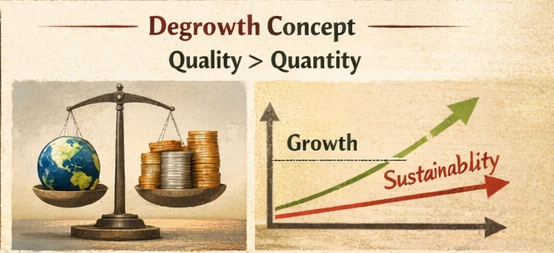
on a finite planet is neither possible nor desirable.
While degrowth is often discussed in economic and policy terms, Aparigraha provides its ethical and philosophical foundation.
It emphasizes:
- Quality over quantity
- Well-being over wealth accumulation
- Ecological balance over unchecked expansion
In this sense, Aparigraha is not anti-development—it is pro-sustainable development, where growth is aligned with planetary limits.
From Philosophy to Practice: Lifestyle Shifts Rooted in Aparigraha
The true strength of Aparigraha lies in its applicability. It is not an abstract ideal—it is a practical guide for daily living.
1. Food Choices:
- Adopting plant-based or low-impact diets
- Avoiding food waste
- Supporting local and seasonal produce
2. Fashion Choices:
The contrast between fast fashion and Aparigraha is particularly striking.
- Fast fashion:
Rapid production, low-cost garments, high environmental impact, and short usage cycles - Aparigraha-based fashion:
Fewer clothes, higher quality, longer use, ethical sourcing
Choosing to repeat, repair, and reuse clothing becomes a powerful environmental act.
3. Mobility Choices:
- Preferring public transport, cycling, or walking
- Reducing unnecessary travel
- Opting for fuel-efficient or electric vehicles
4. Consumption Habits:
- Asking before buying: Do I need this?
- Avoiding impulse purchases
- Prioritizing durability over disposability
These shifts may appear small individually, but collectively, they redefine our relationship with consumption.
Reimagining Progress: From Possession to Purpose

Aparigraha challenges one of the deepest assumptions of modern civilization—that progress is measured by accumulation.
Instead, it invites us to redefine progress as:
- Ecological harmony
- Ethical living
- Conscious consumption
It shifts the focus from having more to being more.
A Civilizational Imperative
As the climate crisis intensifies, it is becoming increasingly clear that technological solutions alone are insufficient. What is required is a transformation in human consciousness.
Aparigraha offers precisely that—a shift from excess to restraint, from consumption to consciousness, from materialism to meaning.
In embracing Aparigraha, we do not lose comfort—we gain clarity.
We do not lose prosperity—we gain sustainability.