


1. Prof. Ashok Kumar (Founder and Chairman)
2. Niranjan Dev Bharadwaj (Researcher and Advisor)
On the sacred occasion of Mahavir Jayanti, we remember and revere Mahavira—a spiritual visionary whose teachings, though articulated over two millennia ago, resonate with profound urgency in today’s age of ecological crisis. While modern environmentalism often emerges from scientific data, policy frameworks, and technological interventions, Mahavira’s philosophy offers something deeper and more enduring: an ethical foundation for our relationship with nature.

At the heart of his teachings lies Ahimsa—commonly understood as non-violence. Yet, to reduce Ahimsa to mere abstention from physical harm is to underestimate its transformative power. In Mahavira’s vision, Ahimsa is not passive restraint; it is an active, conscious commitment to protect, preserve, and respect all forms of life. It is, in essence, the earliest articulation of what we today call ecological ethics.
From Human-Centric Ethics to Biospheric Compassion

Modern ethics has long been anthropocentric—centered around human needs, rights, and progress. However, Mahavira expanded the moral universe far beyond humanity. He envisioned a world where every living being—plants, animals, microorganisms—possesses intrinsic value.
This shift from human-centric to biospheric compassion is revolutionary. It demands that we recognize not just the utility of nature, but its sanctity.
In practical terms, this means:
- Respecting ecosystems as living entities
- Recognizing the rights of non-human life
- Cultivating sensitivity toward even the smallest forms of existence
Mahavira’s teachings remind us that the Earth is not a resource reservoir—it is a living, interconnected community.
Violence Against Nature is Violence Against Life

If Ahimsa is the guiding principle, then its violation becomes starkly visible in today’s environmental realities.
Deforestation is not merely land-use change—it is the destruction of countless life forms.
Pollution is not just contamination—it is the silent suffering of ecosystems.
Species extinction is not a statistic—it is the irreversible loss of life’s diversity.
In this light, the climate crisis can be reinterpreted as a collective manifestation of violence against nature.
- Burning fossil fuels disrupts atmospheric balance
- Industrial expansion fragments habitats
- Overconsumption depletes natural resources
Each of these actions contradicts the spirit of Ahimsa.
Mahavira’s philosophy compels us to confront an uncomfortable truth:
Our developmental models, when detached from ethics, become instruments of violence.
The Interconnected Web of Life: From Micro to Macro
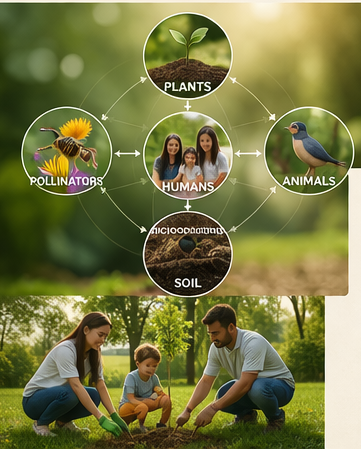
One of the most profound aspects of Mahavira’s thought is his recognition of the interconnectedness of all life forms. Long before ecology emerged as a scientific discipline, he articulated a worldview where every entity is linked in a delicate web of existence.
Modern science now validates this through:
- Ecosystem interdependence
- Food chains and food webs
- Microbial roles in sustaining life
A disturbance in one part of the system reverberates across the whole.
For instance:
- The loss of pollinators affects global food security
- Soil degradation impacts agricultural productivity
- Ocean warming disrupts marine biodiversity
Mahavira’s insight was clear:
Harm to one is harm to all.
This principle aligns seamlessly with the contemporary understanding of planetary boundaries and ecological balance.
Reframing Climate Change: From Science to Moral Responsibility

Today, climate change is often discussed in terms of:
- Carbon emissions
- Temperature rise
- Policy negotiations
While these are critical, they represent only one dimension of the crisis. What is often missing is the ethical narrative.
Mahavira’s teachings invite us to reframe climate change not merely as a scientific or technological challenge, but as a moral and spiritual crisis.
It raises fundamental questions:
- Do we have the right to exploit nature beyond its limits?
- Can progress be justified if it causes irreversible harm to other life forms?
- What responsibilities do we hold toward future generations?
Ahimsa provides a moral compass to navigate these questions. It transforms climate action from obligation to ethical duty.
Ahimsa as a Framework for Climate Action
If we reinterpret Ahimsa in contemporary terms, it translates into actionable pathways:
- Sustainable living: minimizing ecological footprints
- Conscious consumption: reducing waste and excess
- Biodiversity conservation: protecting all forms of life
- Climate responsibility: reducing emissions and supporting green transitions
Ahimsa thus becomes not just a spiritual ideal, but a practical framework for environmental action.
Toward an Ethical Environmentalism
In a world searching for solutions to environmental crises, his philosophy offers a timeless reminder:
Without ethics, sustainability remains incomplete. Without compassion, conservation remains superficial.
Mahavira does not merely ask us to avoid harm—he calls upon us to live in harmony with all existence.
In rediscovering Ahimsa, we rediscover the very soul of environmentalism.