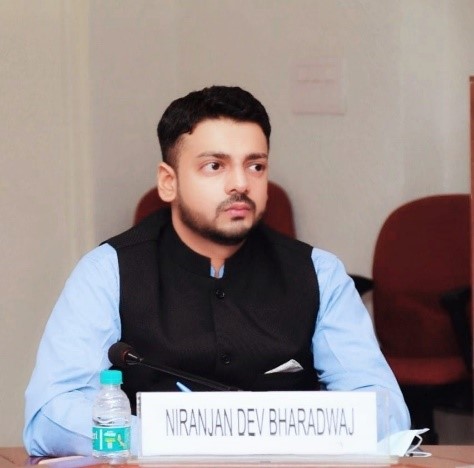
By: Niranjan Dev Bharadwaj
Researcher and Analyst, Global Foundation for Advancement of Environment and Human Wellness. Author, Environmentalist and TED speaker
M.A. in Environment, Development and Peace specialization in Climate Change, United Nations Mandated University for Peace, Costa Rica.
Delhi’s air pollution crisis has often been framed as an emergency—an episodic breakdown requiring urgent but temporary responses. Over time, this framing has shaped policy, public behaviour, and institutional thinking. Yet, as this series has demonstrated, polluted air in Delhi is not an exception to normalcy; it has become part of it.
The persistence of hazardous air quality levels signals a deeper reality: this is not merely an environmental or technical failure. It is a civilisational challenge—one that calls for a fundamental rethinking of values, priorities, and the relationship between human progress and nature.
Beyond Management Toward Meaning
Over the last several blogs, we have examined sources, impacts, governance failures, economic structures, and behavioural dimensions of air pollution. A consistent pattern emerges: responses have focused on managing pollution rather than preventing it, on reacting to crises rather than reshaping systems.
Emergency measures, technological interventions, and advisories may reduce immediate harm, but they do not address the underlying worldview that treats clean air as negotiable—subordinate to convenience, consumption, and short-term growth.
A lasting solution demands something deeper than regulation. It demands a shift in collective consciousness.
Clean Air as a Civilisational Value
Historically, societies that endured and prospered did so by respecting ecological limits. Clean air, water, and soil were understood as shared commons—essential for collective survival and well-being.
In modern urban contexts, this understanding has weakened. Air has become invisible again—not because it is clean, but because its degradation has been normalized. Reimagining clean air as a civilisational value means restoring its ethical, social, and cultural centrality.
Clean air must be seen not as:
- A seasonal aspiration
- A technical benchmark
- Or an individual responsibility
But as a non-negotiable public good, essential to dignity, health, and justice.
The Global Foundation Position
The Global Foundation for Advancement of Environment and Human Wellness affirms that environmental integrity and human well-being are inseparable. Air pollution represents a direct assault on human wellness, disproportionately affecting children, the elderly, the poor, and future generations.
From the Foundation’s perspective:
- Clean air is a human rights issue
- Persistent pollution reflects governance and ethical failure
- Sustainable development is impossible without environmental health
- Human wellness must guide urban and economic planning
Environmental protection cannot remain peripheral to development policy. It must become its ethical core.
From Fragmentation to Integrated Action
One of the central lessons from Delhi’s experience is the danger of fragmented action. Air quality management has been divided across departments, jurisdictions, and timelines, resulting in diluted accountability.
A renaissance approach requires integration:
- Health data must inform environmental policy
- Urban planning must internalize air quality impacts
- Economic incentives must align with ecological limits
- Citizen behaviour must be enabled by supportive systems
This integration is not optional—it is foundational to durable change.
The Role of Institutions, Citizens, and Leadership
Transformation cannot rest on any single actor. Governments must demonstrate continuity and courage. Institutions must move beyond compliance toward stewardship. Citizens must shift from adaptation to participation.
Leadership, in this context, is not about announcing emergency responses, but about sustaining long-term vision—especially when political and economic pressures resist it.
The Global Foundation believes that such leadership must be values-driven, science-informed, and people-centred.
From Pollution Control to Environmental Renaissance
An environmental renaissance is not a return to the past, nor a rejection of development. It is a reorientation—where progress is measured by human wellness, ecological balance, and intergenerational equity.
Delhi’s air pollution crisis, severe as it is, offers an opportunity. It can either reinforce a cycle of reaction and resignation, or become a catalyst for reimagining how cities breathe, grow, and care for their people.
The choice is civilisational.
A Call Forward
The question before us is no longer whether clean air is achievable. It is whether we are willing to reorganize priorities, policies, and practices to protect it.
From crisis must come clarity.
From clarity must come commitment.
From commitment must come transformation.
The Global Foundation for Advancement of Environment and Human Wellness calls upon policymakers, institutions, civil society, and citizens to treat clean air not as an environmental demand alone, but as a shared moral responsibility.
Only then can Delhi—and cities like it—move from chronic crisis to genuine renaissance.