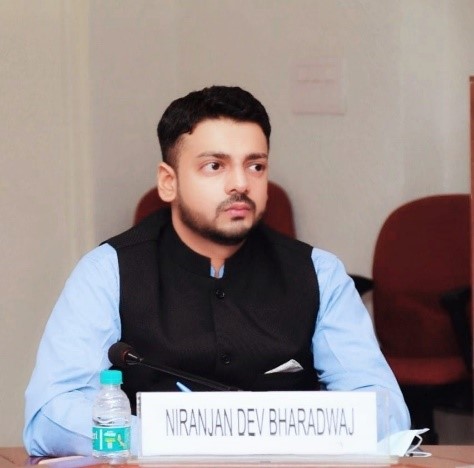
By: Niranjan Dev Bharadwaj
Researcher and Analyst, Global Foundation for Advancement of Environment and Human Wellness. Author, Environmentalist and TED speaker
M.A. in Environment, Development and Peace specialization in Climate Change, United Nations Mandated University for Peace, Costa Rica.
Air pollution is often discussed in technical language—parts per million, particulate matter, emission sources, and regulatory thresholds. Yet, for millions living in Delhi, polluted air is not an abstract environmental statistic; it is a lived reality that enters homes, lungs, schools, and workplaces every single day.
When the air becomes unbreathable, the issue moves beyond environmental degradation. It becomes a question of health, dignity, and fundamental human rights.
From Environmental Hazard to Public Health Emergency
During the recent months of severe pollution in Delhi, hospitals reported a noticeable increase in respiratory distress cases, eye irritation, chronic coughs, and cardiovascular complications. Clinics saw children struggling with breathlessness and elderly patients experiencing aggravated heart and lung conditions.
Unlike many environmental problems that unfold slowly, air pollution delivers immediate harm. There is no buffer period, no adaptation window, and no individual opt-out. Every breath becomes an involuntary exposure.
This immediacy is what transforms air pollution into a public health emergency rather than a distant ecological concern.
Children: Breathing an Inherited Crisis
Children are among the most vulnerable victims of polluted air. Their lungs are still developing, their breathing rates are higher, and their immune systems are more sensitive to environmental toxins. Exposure during early years can lead to long-term respiratory illnesses, reduced lung capacity, and cognitive impacts.
When schools are closed due to hazardous air quality, it is a silent acknowledgment that the environment is no longer safe for learning or play. Yet, school closures are temporary responses to a persistent condition. The larger question remains unanswered: What does it mean to raise a generation in an environment that routinely fails basic health standards?
This is not merely an environmental failure—it is an intergenerational ethical dilemma.
The Unequal Burden of Dirty Air
Air pollution does not affect everyone equally. Outdoor workers—construction laborers, street vendors, sanitation workers, traffic police—spend long hours exposed to toxic air with little or no protective equipment. For them, polluted air is not an occasional inconvenience but an occupational hazard.
Similarly, residents of informal settlements and congested neighborhoods often live closer to pollution sources while lacking access to healthcare or air-purifying infrastructure. Clean indoor air, air purifiers, and medical consultations remain privileges rather than guarantees.
This uneven exposure raises a critical question: Who bears the cost of urban pollution, and who remains insulated from its worst effects?
Air Pollution and the Right to Life
In constitutional and ethical terms, clean air is inseparable from the right to life and the right to health. When air quality consistently falls below safe standards, it signals a systemic failure to protect these rights.
Environmental degradation that compromises human health cannot be dismissed as collateral damage of development. It challenges the moral foundations of governance and economic growth.
At the Global Foundation for Advancement of Environment and Human Wellness, the understanding is clear: environmental protection and human well-being are not parallel goals—they are inseparable. A degraded environment inevitably undermines physical health, mental well-being, and social equity.
Mental Health and the Invisible Toll
Beyond physical illness, polluted air takes a psychological toll. Anxiety over health, restrictions on movement, confinement indoors, and uncertainty about long-term impacts contribute to stress and emotional fatigue.
Parents worry about their children stepping outside. Elderly individuals fear medical emergencies. Citizens experience a growing sense of helplessness as pollution becomes a recurring seasonal threat rather than a resolvable problem.
Environmental distress, though less visible, is a significant and growing consequence of sustained pollution.
Inviting Collective Reflection and Responsibility
If polluted air shortens lives, disrupts childhoods, and deepens inequality, then it demands collective introspection. Are cities being designed for human wellness or mere economic efficiency? Are short-term conveniences outweighing long-term health? And most importantly, are we willing to treat clean air as a shared societal responsibility rather than an individual coping challenge?
The mission of the Global Foundation for Advancement of Environment and Human Wellness rests on precisely this intersection—where environmental integrity meets human dignity. Addressing air pollution is not only about emissions and enforcement; it is about re-centering policy, planning, and public discourse around human well-being.
Looking Ahead
Understanding the human cost of polluted air forces us to confront uncomfortable truths. Emergency health advisories and temporary restrictions may reduce immediate exposure, but they do not address the structural injustice embedded in chronic pollution.
In the next blog, we will examine how governments respond to air pollution—why emergency measures dominate policy responses, and whether Delhi is trapped in a cycle of reaction rather than prevention.
Clean air is not a luxury. It is a right. And protecting it is a shared responsibility that begins with recognizing whose lives are most at stake.