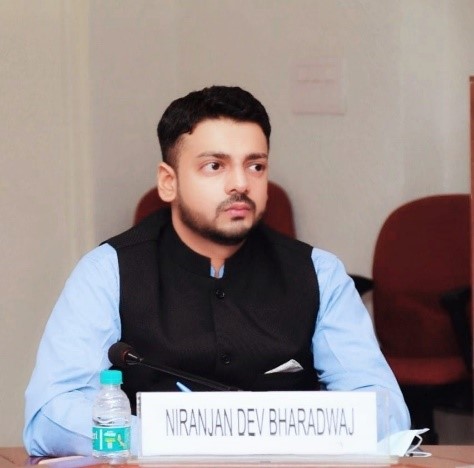
By: Niranjan Dev Bharadwaj
Researcher and Analyst, Global Foundation for Advancement of Environment and Human Wellness. Author, Environmentalist and TED speaker
M.A. in Environment, Development and Peace specialization in Climate Change, United Nations Mandated University for Peace, Costa Rica.
Over the last few months, Delhi has once again found itself enveloped in a thick, toxic haze. Streets disappeared into grey obscurity, public monuments faded into silhouettes, and the air—once invisible and taken for granted—became a daily source of anxiety and alarm. For millions of residents, breathing itself turned into a conscious and cautious act.
This was not an isolated environmental incident, nor was it an unexpected one. The recent air pollution episode in Delhi represents a recurring crisis that has gradually been normalized, despite its profound implications for public health, human dignity, and environmental sustainability.
When Air Quality Becomes a Public Emergency
Air Quality Index (AQI) readings across Delhi consistently crossed into the “very poor” and “severe” categories during this period. Such levels are not merely statistical indicators; they signal conditions under which prolonged exposure can lead to serious health consequences, particularly for children, the elderly, and individuals with pre-existing respiratory or cardiovascular conditions.
Schools were forced to shut down, outdoor activities were restricted, and emergency measures were announced with familiar urgency. Yet, for many residents, these responses felt less like decisive interventions and more like ritualistic reactions—temporary pauses in an otherwise continuous crisis.
The unsettling reality is that Delhi has reached a point where hazardous air is no longer perceived as an extraordinary event but as a seasonal inevitability.
A Crisis That Is Predictable, Yet Persistent
What makes Delhi’s air pollution crisis especially troubling is not its suddenness, but its predictability. Year after year, scientific warnings, policy reports, and judicial observations have clearly outlined the conditions under which air quality deteriorates. Despite this, the city continues to move from one pollution episode to the next, largely unprepared and structurally unchanged.
This predictability exposes a deeper governance failure. When a crisis can be forecast but not prevented, the issue lies not in lack of knowledge, but in lack of sustained political will, institutional coordination, and long-term planning.
More Than Weather, Less Than an Accident
Air pollution in Delhi is often attributed to seasonal or meteorological factors—winter temperatures, low wind speeds, and temperature inversion. While these elements do influence pollution levels, they merely act as amplifiers of an already fragile urban ecosystem.
The true causes are embedded in the city’s development trajectory: unchecked vehicular growth, relentless construction activity, industrial emissions, fossil-fuel dependence, and regional agricultural practices. To describe the crisis as “weather-driven” or “temporary” is to overlook the structural choices that have steadily degraded Delhi’s air over decades.
In this sense, the smog is not an accident of nature; it is a consequence of human decisions.
Living in a State of Environmental Normalisation
Perhaps the most alarming aspect of Delhi’s pollution crisis is the gradual normalization of environmental harm. Residents track AQI levels on mobile applications much like weather forecasts, adjusting their routines rather than questioning the conditions that make such adjustments necessary.
This normalization carries ethical consequences. When toxic air becomes routine, urgency erodes. Emergency responses replace preventive strategies, and long-term vision is sacrificed at the altar of short-term convenience.
The cost of this normalization is not abstract—it is borne in hospital wards, reduced life expectancy, impaired childhood development, and a declining quality of urban life.
Setting the Stage for a Larger Conversation
This blog marks the beginning of a broader inquiry into Delhi’s air pollution crisis. Beyond the visible smog lie complex intersections of science, governance, economics, ethics, and human rights. Addressing the issue demands more than temporary restrictions and emergency advisories; it requires a fundamental rethinking of how cities grow, how resources are consumed, and how environmental responsibility is shared.
In the coming blogs, we will examine what is truly choking Delhi, who pays the price for polluted air, why current responses fall short, and how pathways toward cleaner air can be imagined—rooted in justice, sustainability, and collective action.
Delhi’s air crisis is not merely an environmental challenge. It is a mirror reflecting the choices of our society. The question is no longer whether the city can afford clean air, but whether it can afford to continue without it.